
 |
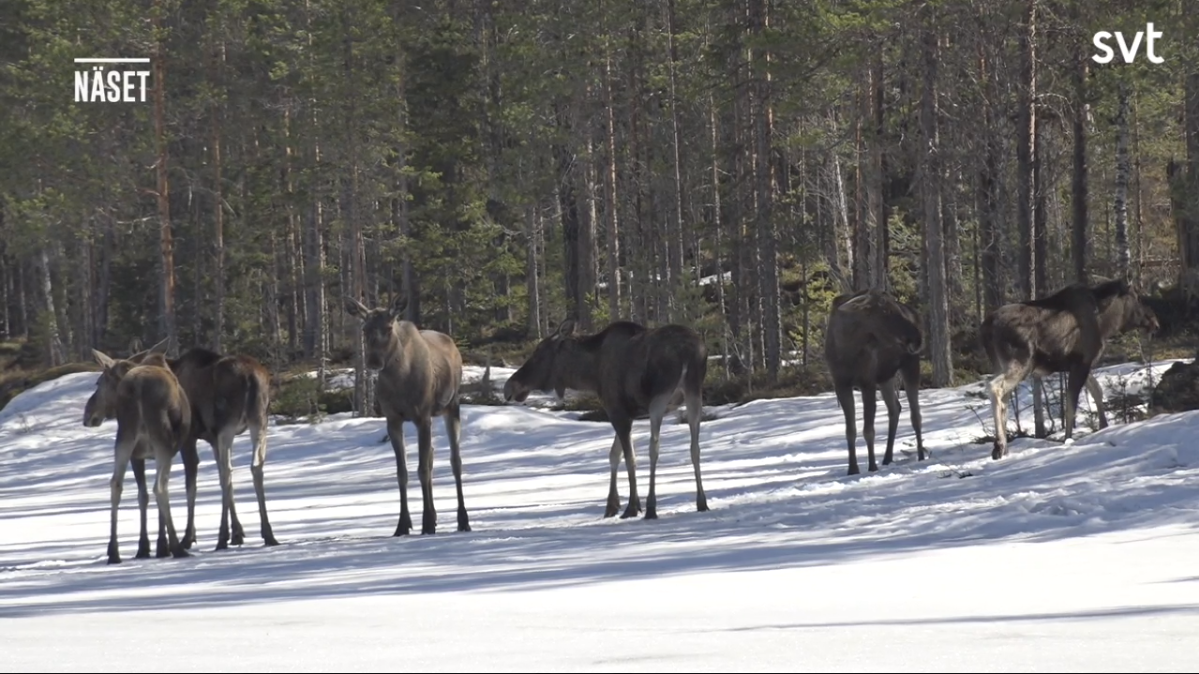
| Day 9. Screenshot from SVT Play. |
It's a comparative, analytical piece, setting out its context and place within the family of Slow TV shows.
The first piece can be read here - The Surprises of Slow TV, which takes a more personal exploration.
Introduction
Den stora älgvandringen (SVT, 2019) (literal translation: “The great moose migration”) was a live three week 24 hour around the clock long Slow TV project by SVT (the Swedish public service television network). It was shown on SVT Play and was available overseas as well. During the off hours in the mornings, the programme was also shown on broadcast television, on Kunskapskanalen (an off shoot TV channel of SVT for science and nature programmes). It ran from 15th of April to 5th of May 2019.
The programme used 15 cameras mounted around a crossing area in the Ångermanälven river in the north of Sweden, where many moose each year cross over on their way to summer grazing. The cameras can pan and zoom through remote control, and there were also drones that allow for aerial footage as well as a remote controlled boat. Three one-hour outdoor studio-type programmes where produced as well, where a host and guests discussed everything related to the moose migration and the program. These were filmed and broadcast live once a week (on Thursdays) on prime time SVT and was basically the only narrated parts / commented parts of the whole experience.
The 24 hour live programme consisted of cutting between the various cameras without commentary, sometimes on a programmed loop but on many occasions when stuff was happening, the cutting between cameras would be directly controlled by operators in the control room who also would pan and zoom with the cameras in order to follow a bird, reindeer or moose or whatever else was deemed interesting to follow. Occasionally there would be text signs overlaying the image to give some short information on things like moose migration or what kind of bird was in the image etc., but these text signs were not (in my experience) very common. Otherwise, there was just a text caption indicating the camera angle and once the moose started swimming, a text box indicating how many had crossed the river.
This text contains some of my personal impressions and reflections, written in the final days of the show (it ended Sunday 5th of May). I use my own experience, as well as impressions I’ve gotten by following along some of the discussions online and with friends and other people around me. As this is an early piece of writing, I haven’t made any thorough research, so a lot of this is will be pure speculation on my part.
I would like do some tentative analysis of the program by comparing it to various style elements used in the Norwegian shows. First of all I must mention that in general the Swedish programme is a much more bare, stripped down program and as such I will note many things the Norwegian shows have, that the Swedish one hasn’t. I don’t see this as something detrimental to the Swedish style of making the program. Rather, I believe there are many valid reasons for the show being constructed the way it is. I am convinced there are many active and conscious decisions on the part of the production team that give the Swedish programme a distinct Slow TV approach that creates a local and national appeal. This is not to say a more “Norwegian” style wouldn’t work for other projects of course.
Note: The comparison below may be a bit of apples vs pears. After I had done my writing I came to realize that one should perhaps more directly compare the Swedish program Älgvandringen to the Norwegian Fuglefjellet Hornøya minutt for minutt (NRK, 2016) or Reinflytting minutt for minutt (NRK, 2017). Still the fact remains that it says something that the first real effort to do Swedish Slow TV has this setup, and not a train ride or something along that line (as did the show that started of Slow TV in Norway).
Absence of journey / “narrative arc”
Many of the Norwegian shows are based around some kind of journey (physical or otherwise), here in Älgvandringen we had a geographically static setup with a fixed duration but without any guarantees as to what would take place (would the moose show up at all during this time?). The journey aspect seems to always be there, in its broadest sense, in the Norwegian shows. It can be there directly, as in a train or boat ride, as in Bergensbanen minutt for minutt (NRK, 2009) and Hurtigruten minutt for minutt (NRK, 2011). But it can also be there as a metaphorical or experience-wise journey, such as when turning wool from a sheep to a sweater as experienced in Nasjonal strikkekveld (NRK, 2013) or the journey from 00:00 to 24:00 as seen in Klokken minutt for minutt (NRK, 2018). All these shows provides what could be called a very loose narrative arc, but still something that has a clear beginning, a middle and an end.
The content-wise closest Norwegian show to the Swedish one may be the previously mentioned Reinflytting, in which the cameras follow along human-guided migrating reindeer. I am not that familiar with that show, but as far as I know it still represent quite directly a journey, that of the reindeers, following a route they take each year (notably I believe they had to end the show before they reached their destination due to a blizzard). The other Norwegian show, Fuglefjellet Hornøya, might be technically even more similar to Älgvandringen with its setup with static cameras monitoring a specific geographical area, but I haven’t seen it so I am just making assumptions.
With the Swedish setup, no real narrative arc was available apart from the fact that some moose would probably show up and move on. There were no guarantees of anything, except to get some long glimpses on nature and wildlife in a specific area. Of course, the anonymous moose were making their journeys, but we couldn’t know if we would be able to see their journeys. Still, many viewers would experience some sort of dramatic high points when they saw moose and then even more so when they saw them crossing the river.
A small attempt to make the moose a little more personal was made by placing radio trackers on three moose (nicknamned "Ärrade damen", "Trygga mamman" and "Jokern" - roughly translated to “The scarred old lady”, “The confident mom” and “The joker”). This was presented in the first one hour studio programme. But the tracking of these moose was, as far as I can tell, not something that was monitored on the 24 hour live programme (notably because they all choose off-camera places to cross). They were monitored by SLU (Swedish University of Agricultural Sciences) and you could get map updates on SLUs website in case you were really interested. People could also vote on which of the three moose would cross first and the grand total of moose crossing. I haven’t seen the other two of the studio programmes yet, but I would imagine they provided updates to these mooses progress. My impression is that the gimmick of the three moose added some flavour but didn’t really matter that deeply to people following the programme (but it did provide some talking points of course).
Few distractions
Many of the Norwegian programs feature things like: added music, inclusion of archival footage, and people. For instance, the Bergensbanen programme would often play Norwegian music that had a connection to places that the train passed through. They would show archival documentary footage when the camera was blacked out by the many tunnels they passed through. The camera would show people on platforms getting on and off, and a mobile camera with reporter would occasionally do short interviews with people on and around the train. A lot of these components were to be present in many of the other Norwegian programs that were to follow.
None of these elements were present in Älgvandringen. The only sounds you would hear were sounds taken up at the same time and place as the cameras were filming. The sounds would be of whatever happened in nature (as well as the muffled traffic noise from the closest road). The sounds would occasionally be very weak, and on some occasions quite strong (some water, rain, and animal noises) seemingly depending on which camera was in view and possibly other parameters. There would be nothing sound-wise throwing you out of the immersion though, as one could argue happens with the Norwegian way of adding music (and allowing some speech from reporters and /or archival material to blend with the footage).
As for archival footage, in the sense of old documentaries and other material - I never noticed any and I have a strong impression there intentionally isn’t any - it simply isn’t part of the setup. In the Norwegian programs, archival footage (usually shown by sharing the screen with the real-time footage) adds a sense of history and a deeper text /experience, but they also contribute a sort of traditional narrative in something otherwise quite slow, and a narrative that is filmed in more traditional editing style that contradicts the ambitions of the real-time footage.
One thing that appeared on occasion in the Swedish programme, and could be defined as archival I guess, was that they would feature “earlier today”- segments where they would show things that had been filmed earlier that day. This was shown by sharing the screen with the ongoing footage, as far as I could tell. These kind of “flashbacks” seemed to be shown during the late evening /night segments, where little was happening or could be seen. But I am not sure how frequent this was, my impression is that it was quite rare, but I haven’t watched enough to know. (As a side note: the fact that the programme ran through the night, but most cameras didn’t seem to have a night vision mode, together with the fact that much less seems to happen during the night, made the late / early hours in darkness a very subtle slow radio experience).
As for people - there were none. And very little indication of human technology or presence. One could occasionally glimpse a car on the distant road that was visible sometimes when the camera panned to follow a swimming moose. One would hear the muffled droning of traffic noises sometimes. Reportedly some viewers could see what was probably the TV crew when they rowed out to fix the cables that had been mauled by a huge ice floe. But no people seemed to have passed by or tried to approach the site in order to appear on camera.
I asked a question on a Facebook group (“Vi som följer Den stora älgvandringen”) for followers of the show, to see if anyone had noticed any people. The above mentioned examples were the only one given, and more than one of the commenters expressed their gratitude for the absence of people. It seems that the lack of people and low presence of man made things was an important factor in the enjoyment of this nature show.
Obviously the cameras themselves would be an indication of the presence of humans, but since they were never visible or appeared in view, our immersion through their “eyes” was quite easy. It was easy to forget they were there (especially at the times the cameras didn’t pan or zoom). There was of course the singular event of a reindeer breaking the fourth wall by looking into the camera.
As for the Norwegian shows, I get the impression that the presence of people seems an important part of the concept in many cases. Not sure in how great a deal this applies to Reinflytting, and I haven’t watched it but I would assume Fuglefjellet Hornøya is close to the Swedish setup in this and other regards. The latter is notable also because it was shown live in Sweden as well, if I recall correctly…) .
Is enjoyment of nature is more of a social thing in Norway, and more of a solitary thing in Sweden? Maybe it doesn’t differ so much in practice (we like to go out in nature together here as well), but maybe the social aspect is something we don’t want / need to be mirrored when we’re watching nature. Here the presence of people is a distraction. Maybe this is different for Norwegians?
More information and sources
Since the purpose of this text has been to quickly express some personal reflections, I haven’t been thoroughly collecting sources /references, but here are some further information:
Background and related information on the show
These two linked articles give some general technical information as well as information on the SLU’s tagging of the moose.
The show itself
Den stora älgvandringen (SVT, 2019)
The actual programme can be viewed here.
The leaping reindeer is highlighted here.
Norwegian shows mentioned
Bergensbanen minutt for minutt (NRK, 2009)
Fuglefjellet Hornøya minutt for minutt (NRK, 2016)
Hurtigruten minutt for minutt (NRK, 2011)
Reinflytting minutt for minutt (NRK, 2017)
Many thanks to Björn for his analysis of this Slow TV. It's pleasing to share from another person similarly motivated to reflect upon this format, why and how it might work.
See also on Facebook: Slow TV Fans, Thinkers and Film Makers.
Slow Television - The Slow TV Blog
The first piece can be read here - The Surprises of Slow TV, which takes a more personal exploration.
Some thoughts and perspectives on SVT’s programme Den stora älgvandringen
By Björn Lindell
Introduction
Den stora älgvandringen (SVT, 2019) (literal translation: “The great moose migration”) was a live three week 24 hour around the clock long Slow TV project by SVT (the Swedish public service television network). It was shown on SVT Play and was available overseas as well. During the off hours in the mornings, the programme was also shown on broadcast television, on Kunskapskanalen (an off shoot TV channel of SVT for science and nature programmes). It ran from 15th of April to 5th of May 2019.
The programme used 15 cameras mounted around a crossing area in the Ångermanälven river in the north of Sweden, where many moose each year cross over on their way to summer grazing. The cameras can pan and zoom through remote control, and there were also drones that allow for aerial footage as well as a remote controlled boat. Three one-hour outdoor studio-type programmes where produced as well, where a host and guests discussed everything related to the moose migration and the program. These were filmed and broadcast live once a week (on Thursdays) on prime time SVT and was basically the only narrated parts / commented parts of the whole experience.
The 24 hour live programme consisted of cutting between the various cameras without commentary, sometimes on a programmed loop but on many occasions when stuff was happening, the cutting between cameras would be directly controlled by operators in the control room who also would pan and zoom with the cameras in order to follow a bird, reindeer or moose or whatever else was deemed interesting to follow. Occasionally there would be text signs overlaying the image to give some short information on things like moose migration or what kind of bird was in the image etc., but these text signs were not (in my experience) very common. Otherwise, there was just a text caption indicating the camera angle and once the moose started swimming, a text box indicating how many had crossed the river.
This text contains some of my personal impressions and reflections, written in the final days of the show (it ended Sunday 5th of May). I use my own experience, as well as impressions I’ve gotten by following along some of the discussions online and with friends and other people around me. As this is an early piece of writing, I haven’t made any thorough research, so a lot of this is will be pure speculation on my part.
 |
| The Great Moose Migration - Courtesy SVT |
Note: The comparison below may be a bit of apples vs pears. After I had done my writing I came to realize that one should perhaps more directly compare the Swedish program Älgvandringen to the Norwegian Fuglefjellet Hornøya minutt for minutt (NRK, 2016) or Reinflytting minutt for minutt (NRK, 2017). Still the fact remains that it says something that the first real effort to do Swedish Slow TV has this setup, and not a train ride or something along that line (as did the show that started of Slow TV in Norway).
Absence of journey / “narrative arc”
Many of the Norwegian shows are based around some kind of journey (physical or otherwise), here in Älgvandringen we had a geographically static setup with a fixed duration but without any guarantees as to what would take place (would the moose show up at all during this time?). The journey aspect seems to always be there, in its broadest sense, in the Norwegian shows. It can be there directly, as in a train or boat ride, as in Bergensbanen minutt for minutt (NRK, 2009) and Hurtigruten minutt for minutt (NRK, 2011). But it can also be there as a metaphorical or experience-wise journey, such as when turning wool from a sheep to a sweater as experienced in Nasjonal strikkekveld (NRK, 2013) or the journey from 00:00 to 24:00 as seen in Klokken minutt for minutt (NRK, 2018). All these shows provides what could be called a very loose narrative arc, but still something that has a clear beginning, a middle and an end.
The content-wise closest Norwegian show to the Swedish one may be the previously mentioned Reinflytting, in which the cameras follow along human-guided migrating reindeer. I am not that familiar with that show, but as far as I know it still represent quite directly a journey, that of the reindeers, following a route they take each year (notably I believe they had to end the show before they reached their destination due to a blizzard). The other Norwegian show, Fuglefjellet Hornøya, might be technically even more similar to Älgvandringen with its setup with static cameras monitoring a specific geographical area, but I haven’t seen it so I am just making assumptions.
With the Swedish setup, no real narrative arc was available apart from the fact that some moose would probably show up and move on. There were no guarantees of anything, except to get some long glimpses on nature and wildlife in a specific area. Of course, the anonymous moose were making their journeys, but we couldn’t know if we would be able to see their journeys. Still, many viewers would experience some sort of dramatic high points when they saw moose and then even more so when they saw them crossing the river.
A small attempt to make the moose a little more personal was made by placing radio trackers on three moose (nicknamned "Ärrade damen", "Trygga mamman" and "Jokern" - roughly translated to “The scarred old lady”, “The confident mom” and “The joker”). This was presented in the first one hour studio programme. But the tracking of these moose was, as far as I can tell, not something that was monitored on the 24 hour live programme (notably because they all choose off-camera places to cross). They were monitored by SLU (Swedish University of Agricultural Sciences) and you could get map updates on SLUs website in case you were really interested. People could also vote on which of the three moose would cross first and the grand total of moose crossing. I haven’t seen the other two of the studio programmes yet, but I would imagine they provided updates to these mooses progress. My impression is that the gimmick of the three moose added some flavour but didn’t really matter that deeply to people following the programme (but it did provide some talking points of course).
Few distractions
Many of the Norwegian programs feature things like: added music, inclusion of archival footage, and people. For instance, the Bergensbanen programme would often play Norwegian music that had a connection to places that the train passed through. They would show archival documentary footage when the camera was blacked out by the many tunnels they passed through. The camera would show people on platforms getting on and off, and a mobile camera with reporter would occasionally do short interviews with people on and around the train. A lot of these components were to be present in many of the other Norwegian programs that were to follow.
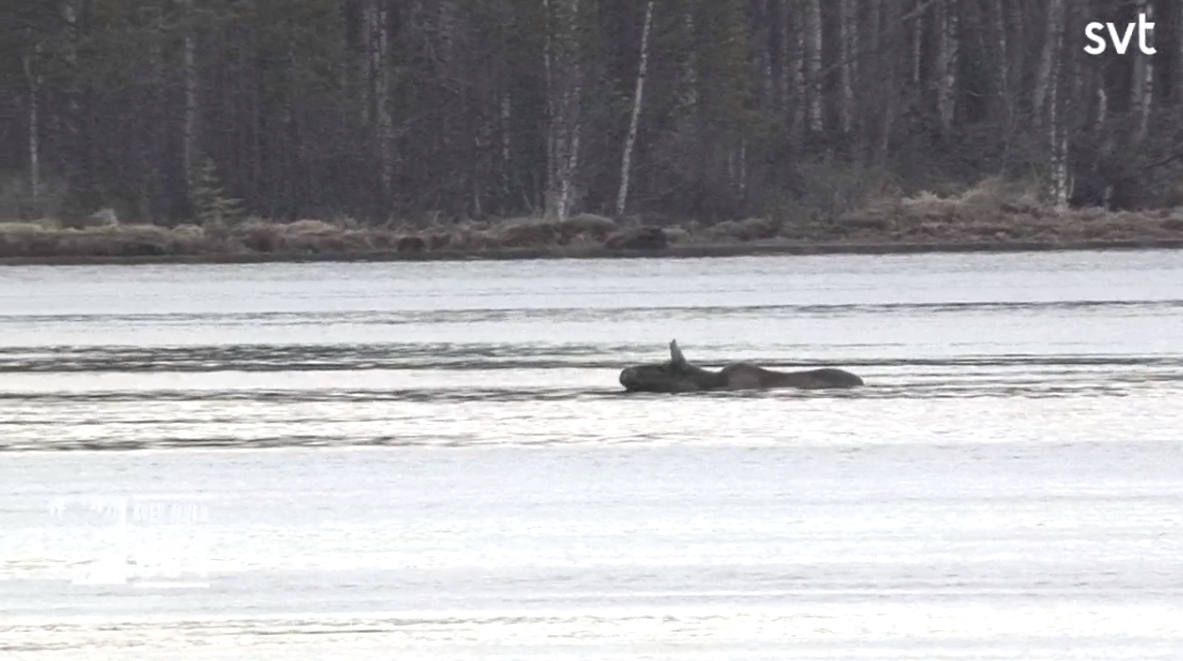 |
| The soon to be 55th moose having crossed the river, day 17 Screenshot from SVT Play. |
As for archival footage, in the sense of old documentaries and other material - I never noticed any and I have a strong impression there intentionally isn’t any - it simply isn’t part of the setup. In the Norwegian programs, archival footage (usually shown by sharing the screen with the real-time footage) adds a sense of history and a deeper text /experience, but they also contribute a sort of traditional narrative in something otherwise quite slow, and a narrative that is filmed in more traditional editing style that contradicts the ambitions of the real-time footage.
One thing that appeared on occasion in the Swedish programme, and could be defined as archival I guess, was that they would feature “earlier today”- segments where they would show things that had been filmed earlier that day. This was shown by sharing the screen with the ongoing footage, as far as I could tell. These kind of “flashbacks” seemed to be shown during the late evening /night segments, where little was happening or could be seen. But I am not sure how frequent this was, my impression is that it was quite rare, but I haven’t watched enough to know. (As a side note: the fact that the programme ran through the night, but most cameras didn’t seem to have a night vision mode, together with the fact that much less seems to happen during the night, made the late / early hours in darkness a very subtle slow radio experience).
 |
| The Great Moose Migration - Courtesy SVT |
I asked a question on a Facebook group (“Vi som följer Den stora älgvandringen”) for followers of the show, to see if anyone had noticed any people. The above mentioned examples were the only one given, and more than one of the commenters expressed their gratitude for the absence of people. It seems that the lack of people and low presence of man made things was an important factor in the enjoyment of this nature show.
Obviously the cameras themselves would be an indication of the presence of humans, but since they were never visible or appeared in view, our immersion through their “eyes” was quite easy. It was easy to forget they were there (especially at the times the cameras didn’t pan or zoom). There was of course the singular event of a reindeer breaking the fourth wall by looking into the camera.
As for the Norwegian shows, I get the impression that the presence of people seems an important part of the concept in many cases. Not sure in how great a deal this applies to Reinflytting, and I haven’t watched it but I would assume Fuglefjellet Hornøya is close to the Swedish setup in this and other regards. The latter is notable also because it was shown live in Sweden as well, if I recall correctly…) .
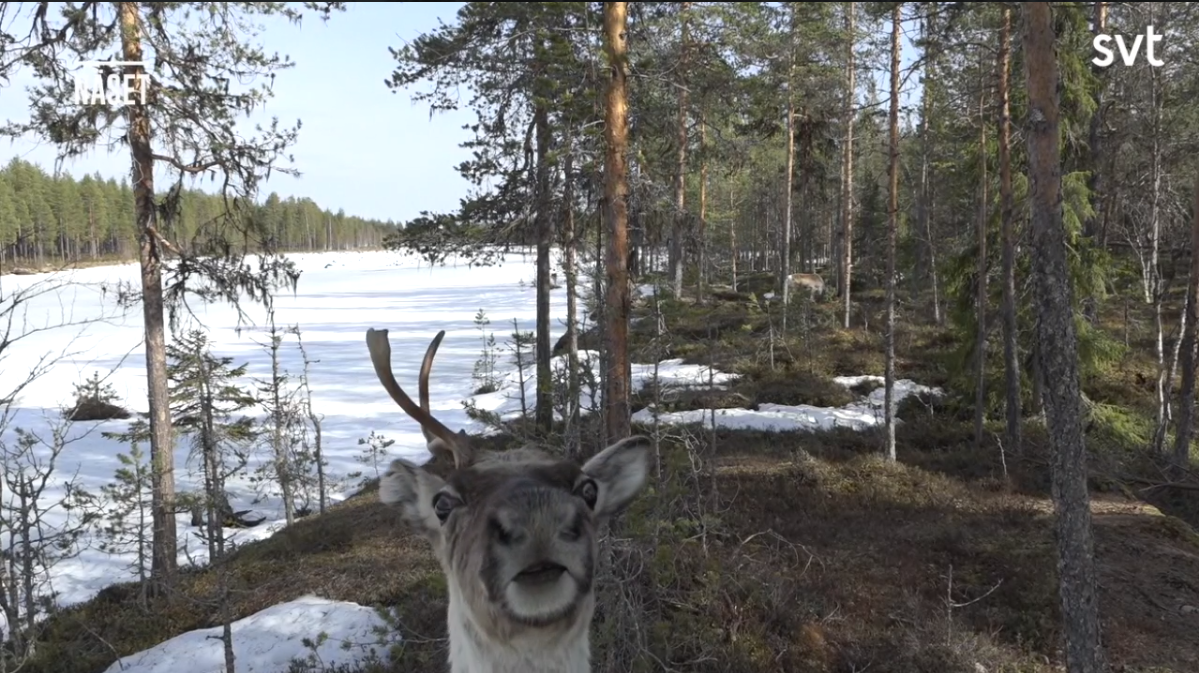 |
| Reindeer leaping at the camera, day 8. Screenshot courtesy SVT Play. |
More information and sources
Since the purpose of this text has been to quickly express some personal reflections, I haven’t been thoroughly collecting sources /references, but here are some further information:
Background and related information on the show
These two linked articles give some general technical information as well as information on the SLU’s tagging of the moose.
The show itself
Den stora älgvandringen (SVT, 2019)
The actual programme can be viewed here.
The leaping reindeer is highlighted here.
Norwegian shows mentioned
Bergensbanen minutt for minutt (NRK, 2009)
Fuglefjellet Hornøya minutt for minutt (NRK, 2016)
Hurtigruten minutt for minutt (NRK, 2011)
Reinflytting minutt for minutt (NRK, 2017)
Many thanks to Björn for his analysis of this Slow TV. It's pleasing to share from another person similarly motivated to reflect upon this format, why and how it might work.
See also on Facebook: Slow TV Fans, Thinkers and Film Makers.
Slow Television - The Slow TV Blog


